Look, there are some deer ! Deer are very common in and around Cutler's but to many people they are just deer, almost as if there were only one type of deer in the UK. Actually, there are six different types of deer in the UK. The indigenous red and roe deer, the fallow deer and the most recent introductions of sika, muntjac and chinese water deer.
All the wild deer around Cutler's are fallow deer. Fallow are really a semi-indigenous species in the UK, they were around during Norman times and may even have been brought by the Romans. Fallow were probably indigenous before the ice ages but migrated to southern Europe as the weather became colder and only came back with the Romans or Normans.
Roe and red deer became extinct in much of Britain due to overhunting and were gone from our area of Kent by 1700. Fallow on the other hand, being a herd animal, were kept in parks and estates (from which many escaped) for hunting and show and this is what most definitely saved them also becoming extinct.
Even though they are all called deer, roe, red and fallow have some quite significant differences and roe deer in particular are quite far removed from both of the other types, being more closely related to the elk of northern Europe than to red or fallow deer. Red deer are the largest deer followed by fallow and roe deer are considerably smaller. Both red and fallow deer tend to live in herds or groups depending on the time of year, whereas roe deer tend to live alone or in small family groups. The roe bucks are extremely territorial and can be very aggressive when protecting their territory.
Fallow bucks are easily identified by the flattened forked surfaces of their antlers. Both red stags and roe bucks have round forked antlers. Deer loose their antlers every year after which they immediately begin to grow a new pair. This is opposed to bovine animals (horned) animals which keep the same horns, which continue growing, for life. The age of horned animals can be told by counting the growth rings on their horns much like growth rings of a tree.
Fallow bucks loose their antlers around April, after which the new antlers begin to grow. During the growth period the antlers are covered with a velvety skin. After the growth period the skin dies off and the bucks will rub the skin off on smaller trees and bushes, which causes quite some damage to the bark. The antlers of older bucks will have finished growing by September i.e. a set of antlers will grow from nothing in around five months !
The fallow rutting season starts in October and goes into November. The bucks will turn up at the rutting places and can be heard over quite long distances by their grunting. One interesting fact of the fallow rut is that it is the does who choose the buck and not vice versa as with red deer. Girl power !
Fawns are born after 7.5 months in June or July, mostly a single fawn but sometimes twins.
As new born fawns are often not able to follow their mother, the mother will leave them hidden in undergrowth while she feeds. People coming across a young fawn often think it to have lost its mother. Leave it alone ! The mother is probably not far away and will return.
Fallow deer are not as selective as roe deer as to their feeding and can cope with much rougher food than roe deer. Fallow feed on grasses, herbs, leaves, buds, fungi, bark, chestnuts, acorns and all manner of farm crops and fruit which makes it an arch enemy of most farmers.
Fallow can also see much better than roe deer and can also detect non-moving subjects which roe often can't. If you come across roe deer and immediately stand still the chances are the roe will not see you and will ignore you if you are downwind of him. In the same circumstances a fallow will usually be long gone.
Roe bucks loose their antlers between October and December after which their new antlers grow until around May / June. The rut then takes place in August.
Now something amazing happens; after fertilization embryonic development is delayed for four months until December after which foetal growth starts and kits are born in May or June. It is this dormant state of embryonic development that has enabled roe deer to survive without the danger of their kits being born in the depths of winter.
Roe deer, although hunted to extinction in many parts of the UK have steadily been recolonizing the country for some time. They are present in western Kent but the channel tunnel high speed rail link and the M20 are barriers to migration. The M/A2 also presents a barrier to recolonization. However, in 2011 roe deer were first sighted living around the Faversham area which is only 8 miles from Cutler's and the British Deer Society is of the opinion that within ten years, roe deer will have successfully recolonizied all of Kent.
It will be a great day when roe deer, and later perhaps red deer, eventually recolonize the area.
.JPG)
BLUEBELL TIME

Edward Hasted´s map of Cutler´s area published 1798 but showing the area apparently around 1778. Cutler´s Farm seems not to have existed yet.
Tuesday, 5 March 2013

Wednesday, 27 February 2013
Huts
Looking at the last post I see that has been over a year since I last wrote anything. Last September we took part in the Weald Wood Fair which was interesting, even if it didn't earn any money after costs were taken into account. There was certainly a fantastic atmosphere at the show and the live music on Saturday night was great. I think that this fair is an excellent opportunity for everybody who has anything to do with woods or timber to come together once a year. I did buy two oak huts there which were built at Plumpton College in Flimwell during oak frame building courses by students. These were transported to Cutler's and erected by the very capable people at Sussex Oak Frame Builders. These huts have been put up in the woods to act as shelters and hides for watching wildlife. Martin and John have been busy in December and January felling some sweet chestnut and then saw milling it to clad the roof and sides of the huts. The result can be seen in the pictures and I think is very good. Being made of oak and chestnut, these huts will probably be around long after we have gone.
It was in November that we had visitors of the not welcome kind at the farmyard. Martin had bogged his Land Rover down at a neighbouring farm one evening. Normally the Land Rover was used to block in our timber trailer in the barn and would be chained together with the trailer. The next morning the trailer was gone. The thieves had come through King's Wood and cut a hole in the fence at the end of our field and got the trailer out, even though the timber grab was hung on a large log. It is obvious that the thieves are locals who know the area very well and had been watching our farmyard for some time. These people are the scourge of the British countryside but unfortunately the police seem powerless to do anything at all. In our case the police took down details but made no effort to try follow any tracks through King's Wood.
Woodcock have been quite prevalent this winter, there are certainly more than last winter. We believe these birds to be migrants from Russia and Eastern Europe.
We have been coppicing another two acres this winter and things are developing nicely. It is amazing how previously dormant seeds suddenly germinate once light gets onto previously shaded out areas. An area we cut two years ago for example was full of foxgloves last spring for the first time in decades.
.jpg)
.jpg)
It was in November that we had visitors of the not welcome kind at the farmyard. Martin had bogged his Land Rover down at a neighbouring farm one evening. Normally the Land Rover was used to block in our timber trailer in the barn and would be chained together with the trailer. The next morning the trailer was gone. The thieves had come through King's Wood and cut a hole in the fence at the end of our field and got the trailer out, even though the timber grab was hung on a large log. It is obvious that the thieves are locals who know the area very well and had been watching our farmyard for some time. These people are the scourge of the British countryside but unfortunately the police seem powerless to do anything at all. In our case the police took down details but made no effort to try follow any tracks through King's Wood.
Woodcock have been quite prevalent this winter, there are certainly more than last winter. We believe these birds to be migrants from Russia and Eastern Europe.
We have been coppicing another two acres this winter and things are developing nicely. It is amazing how previously dormant seeds suddenly germinate once light gets onto previously shaded out areas. An area we cut two years ago for example was full of foxgloves last spring for the first time in decades.
.jpg)
.jpg)
Thursday, 23 February 2012
Logging with John & Bob (The Horse)
Back in Spring 2011 I asked local woodsman and horse logger, John Mancini, to extract some larger sweet chestnut stems from an area of Cutler´s difficult to access with a tractor. John used his horse Bob for the extraction work and these are some pictures of Bob at work. There is something special seeing horses at work and there are the added advantages of less soil compaction and the horses ability to work in tight areas where the use of a tractor would cause considerable ground damage. They are also surprisingly quick.
.jpg)
.jpg)
.jpg)
.jpg)
.jpg) All photography by John Mancini
All photography by John Mancini
.jpg)
.jpg)
.jpg)
.jpg)
.jpg)
Wednesday, 7 December 2011
Sheep
We have now completed the fencing around the top field at Cutler´s Farm and ewes have been put out to graze the pasture. The sheep flock belongs to our neighbours Rachel and Jim Stanford and are a cross between Suffolk, Mule and Texel sheep. This field has not been grazed for quite a number of years and would have slowly returned to scrub without grazing or regular mowing.


Friday, 4 November 2011
Fairies sighted at Cutler´s Wood !!!
Here are some pictures from a Ella-Louise´s birthday Fairy Walk. If anybody reading this would like to have their own Fairy Walk (or any other kids woodland activity) at Cutler´s Wood please contact us for more details.


Photography by Carol Fulton, Canterbury, http://www.carolfulton.co.uk/
Wednesday, 26 October 2011
Pictures of Autumn


HOLES IN THE GROUND
Walking through Cutler´s Wood you find many holes, craters, ditches and embankments, the explanations for which are not always obvious. Some are so called dene holes, although what they actually were for, nobody can really say. Some will be chalk quarries or pits, others perhaps for extracting the flint nodules from the clay. Some may be bomb or even V1 flying bomb craters from WWII. Some 8000 V1 flying bombs aimed at London, fell sort of target and crashed into Kent. A USAF Grumman Avenger fighter bomber also crashed into Cutler´s Wood during WWII, the pilot of which escaped by bailing out. Quite a bit of the Battle of Britain took place in the skies above this part of Kent.
There are ditches and embankments, which may mark boundaries such as parish boundaries or the very boundary of the wood itself, this especially conspicuous on the western edge of Fagg´s Wood. Other bank and ditch systems may be much older, perhaps the remains of enclosures for animals or settlements. The ditch would nearly always be on the outside and the bank on the inside and would be designed to protect whatever was in the enclosure or to stop it escaping into the woodland.
One form of hole in the ground which is easier to identify is a saw pit, of which there are a number in Cutler´s Wood. Nearly always at the bottom of a slope (you wouldn´t want to roll sawlogs uphill, would you?) and next to a track for ease of extraction of the saw planks, they are longer than wide and the spoil from the pit will be still visible piled next to the pit. Originally they would have been deep enough for one sawyer to be in the pit sawing upwards and another sawyer would be on the plank sawing downwards. The bottom picture of the above series of photographs shows the remains of a sawpit alongside a track near Cutler´s Farm.
Photography by Carol Fulton, Canterbury, http://www.carolfulton.co.uk/
Wednesday, 24 August 2011
The Woodsman
Historically Cutler´s always had a woodsman present to work in the woods and he would inevitably know every corner of the woods and what went on there through the seasons and over the years. If you read the excerpt from Somerset de Chair´s book "Die? I thought I´d laugh" at the bottom of this blog, the woodsman Black and his family obviously played an important role at Cutler´s in the past. In the 1970´s, 1980´s and 1990´s Bob Ward from Molash was the woodsman who worked for the then owner, Ralph Reed from Chilham. Bob Ward died in 2002 and since then there has been no woodsman present at Cutler´s.
I am therfore very pleased to say that, from September 2011 onwards, Cutler´s will once again have a woodsman (and family) present in the form of Martin and Katey Hugi. Martin and Katey have being working out of an estate in Hertfordshire until recently and have built up a company called Eco Tree Care (http://www.ecotreecare.co.uk/). The estate in Hertfordshire has now been sold and they have had to move on. Martin and Katey share my views on how the future of Cutler´s can be developed in an ecologically sustainable way, whilst still realizing the history and background of Cutler´s and the surrounding area.
They both bring with them the knowledge and experience as well as the machinery and equipment to work the woods and help develop such things as the woodfuel market and the amenity and activity aspects. Martin is also a tree surgeon and Katey an expert in orchards. Their website mentioned above is a mine of information and can be recommended.
I am therfore very pleased to say that, from September 2011 onwards, Cutler´s will once again have a woodsman (and family) present in the form of Martin and Katey Hugi. Martin and Katey have being working out of an estate in Hertfordshire until recently and have built up a company called Eco Tree Care (http://www.ecotreecare.co.uk/). The estate in Hertfordshire has now been sold and they have had to move on. Martin and Katey share my views on how the future of Cutler´s can be developed in an ecologically sustainable way, whilst still realizing the history and background of Cutler´s and the surrounding area.
They both bring with them the knowledge and experience as well as the machinery and equipment to work the woods and help develop such things as the woodfuel market and the amenity and activity aspects. Martin is also a tree surgeon and Katey an expert in orchards. Their website mentioned above is a mine of information and can be recommended.
Saturday, 11 June 2011
Cleaving
Last year I had the idea of looking for a furniture designer who could produce exceptional pieces of furniture using timber from Cutler´s Wood. These pieces should not be anonymous items from anonymous timber from an anonymous forest somewhere, which would end up being thrown away in a few years, like so much of what is on the market today. Much more so the piece should be an extention of the very tree itself, a continuation of the life of the tree into the future long after the tree itself had actually been felled. We would document the piece, in photographs, from the tree standing in the woods, through the felling process, on into the manufacturing of the item. The people involved would be documented, the woodsmen felling the tree, the transportation of the stem to the yard, the furniture maker actually turning the stem into the piece of furniture through the various phases. The documentation should serve to show coming generations how the piece came about, as the piece hopefully would live on long after the people involved were gone.
The documentation would be the story, the story of the woods, the tree, the people and the piece of furniture as the end product.
It appeared to me that in our Consumption led times we often know little of the items we are actually consuming, items bought are anonymous, we buy and consume with mostly no thought of where it came from or what the original material was, or how it came to end up on our plate or in our homes. The McDonalds syndrome perhaps? Hamburgers come from there don´t they? What have pigs or cows got to do with it all? How can respect be shown for the life that went to make the end product if we have no connection with its past? Our ancestors probably didn´t have this problem, they were often involved in all parts of the making of what they consumed, perhaps through that they were able to accept the natural cycles of life and death better than we can.
I approached Alun Heslop of Chaircreative (http://www.chaircreative.com/) with my ideas and Alun was immediately enthusiastic and agreed to design and manufacture a series of pieces. Alun has made some fantastic items of furniture in the past and his designer talent seemingly knows no bounds.
In February I wanted to fell some larger stems of sweet chestnut in order to ascertain the internal quality of the timber. Alun came along that day and we selected stems which most people would not have been interested in, stems with natural curves and bends, for the furniture should not have sharp corners or straight edges, they were to be something special, perhaps a touch of Gaudi or Dali.
Alun recently started work on the pieces by cleaving some stems before them being taken to his workshops.
The story has started - to be continued.


The documentation would be the story, the story of the woods, the tree, the people and the piece of furniture as the end product.
It appeared to me that in our Consumption led times we often know little of the items we are actually consuming, items bought are anonymous, we buy and consume with mostly no thought of where it came from or what the original material was, or how it came to end up on our plate or in our homes. The McDonalds syndrome perhaps? Hamburgers come from there don´t they? What have pigs or cows got to do with it all? How can respect be shown for the life that went to make the end product if we have no connection with its past? Our ancestors probably didn´t have this problem, they were often involved in all parts of the making of what they consumed, perhaps through that they were able to accept the natural cycles of life and death better than we can.
I approached Alun Heslop of Chaircreative (http://www.chaircreative.com/) with my ideas and Alun was immediately enthusiastic and agreed to design and manufacture a series of pieces. Alun has made some fantastic items of furniture in the past and his designer talent seemingly knows no bounds.
In February I wanted to fell some larger stems of sweet chestnut in order to ascertain the internal quality of the timber. Alun came along that day and we selected stems which most people would not have been interested in, stems with natural curves and bends, for the furniture should not have sharp corners or straight edges, they were to be something special, perhaps a touch of Gaudi or Dali.
Alun recently started work on the pieces by cleaving some stems before them being taken to his workshops.
The story has started - to be continued.


Sunday, 1 May 2011
Easter 2011 at Cutler´s
Easter 2011 at Cutler´s turned out to be almost like high summer; temperatures were up to 26 degrees C for a few days, until an easterly wind brought lower temperatures but it stayed dry and rain was nowhere to be seen. The ground is now so dry that our woodland tracks are like concrete. In all of this I was attempting to plant 200 Nordmann Firs, as future Christmas trees. Luckily, they were rooted in Jiffy bags and not bare rooted. The ground in the paddock, where we were planting was so hard that we had to call Alex in with his tractor and rotovator to break up the top 25cm of earth. We watered the plants in well but I can only now hope that rain appears soon.
The warm weather had also brought the adders out to bask in the sun. One young adder, about 1 year old got ran over in our farmyard by someone and while watering in the Christmas trees another, this time fully adult adder appeared about 1 metre in front of me. After I stood up straight, he seemed to have second thoughts about me and disappeared into the long grass under a fence. We almost stepped on a third snake the next day in the woods.

The warm weather had also brought the adders out to bask in the sun. One young adder, about 1 year old got ran over in our farmyard by someone and while watering in the Christmas trees another, this time fully adult adder appeared about 1 metre in front of me. After I stood up straight, he seemed to have second thoughts about me and disappeared into the long grass under a fence. We almost stepped on a third snake the next day in the woods.


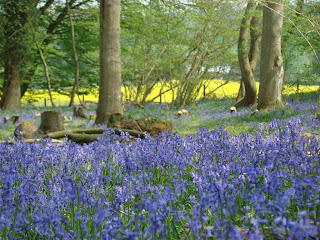
The bluebells were in full bloom over Easter and the woods were carpeted by a sheet of blue. The area next to the A252, which we cut back earlier this year for logs, was particularly impressive and consequently was a big draw for people passing by car, many of whom stopped to walk through the area and take photographs.
There have been a couple of cases of poachers shooting deer in Cutler´s recently. In both cases the deer was left by the poacher - I can´t quite work out the draw of shooting deer only to leave the carcasses to the foxes. Anyway, any poachers which are caught will be prosecuted and have their weapons confiscated and destroyed.
We also managed a trip over to Wilderness Wood in East Sussex to meet Chris Yarrow who has been converting sweet chestnut coppice to high forest for some time now. The high forest will then be managed in future as continuous cover forestry. This is something that I am keen to follow at Cutler´s, as the market for coppiced sweet chestnut, other than for logs, is basically worth almost nothing. Sweet chestnut grows quite well at Cutler´s and we have discovered that the market for well grown sweet chestnut timber is specialized but can be very profitable, as not that much exists. Apart from local interest, there is a certain amount of interest from continental European markets for British sweet chestnut timber, as in the UK we have not had the same incidences of disease that have occured in warmer climatic zones. Anyway, to come back to Wilderness Wood, it is now run by Chris´s daughter Joanna Yarrow and it is an excellent example of what a multi-functional woodland can be. They get around 30,000 paying visitors per year for all manner of activities; childrens birthdays in the woods, barbeques, Christmas trees, walks and many other things. It took Chris 30 years to build up the business of Wilderness Wood but it is now a model of what can be done with enough initiative. http://www.wildernesswood.co.uk/
Apart from the above photos, please click on the "Images of Easter 2011" page in the right hand column to see more pictures.
There have been a couple of cases of poachers shooting deer in Cutler´s recently. In both cases the deer was left by the poacher - I can´t quite work out the draw of shooting deer only to leave the carcasses to the foxes. Anyway, any poachers which are caught will be prosecuted and have their weapons confiscated and destroyed.
We also managed a trip over to Wilderness Wood in East Sussex to meet Chris Yarrow who has been converting sweet chestnut coppice to high forest for some time now. The high forest will then be managed in future as continuous cover forestry. This is something that I am keen to follow at Cutler´s, as the market for coppiced sweet chestnut, other than for logs, is basically worth almost nothing. Sweet chestnut grows quite well at Cutler´s and we have discovered that the market for well grown sweet chestnut timber is specialized but can be very profitable, as not that much exists. Apart from local interest, there is a certain amount of interest from continental European markets for British sweet chestnut timber, as in the UK we have not had the same incidences of disease that have occured in warmer climatic zones. Anyway, to come back to Wilderness Wood, it is now run by Chris´s daughter Joanna Yarrow and it is an excellent example of what a multi-functional woodland can be. They get around 30,000 paying visitors per year for all manner of activities; childrens birthdays in the woods, barbeques, Christmas trees, walks and many other things. It took Chris 30 years to build up the business of Wilderness Wood but it is now a model of what can be done with enough initiative. http://www.wildernesswood.co.uk/
Apart from the above photos, please click on the "Images of Easter 2011" page in the right hand column to see more pictures.
Sunday, 27 March 2011
Plastic, Metal & Stone
 After the storm of 1987, Cutler´s was heavily replanted with ash, black walnut and wild cherry. Plastic tree shelters were used to protect these trees against deer browsing and rabbit / grey squirrel damage. These tree shelters were meant to biodegrade with time but unfortunately they have steadfastly refused to do just this. The consequence of this is that we now, over twenty years later, are faced with the cleaning up of these seemingly many thousands of shelters, both from the ground, if they split and fell off as they were supposed to, or worse still, off the tree if still attached to the stem of the tree. In the case of those still attached to the stems, they are a collection point for water, which rots the bark, or all manner of other things which fall down the tube - we even found a dead squirrel stuck down one shelter. The clean up has until now taken all winter and we are still nowhere near finished. We think it may take years still to eventually clear up last shelter. Perhaps the moral of the story here is "Never believe what´s on the label".
 Some time ago I came across a number of num
 bered corrugated metal sheets and pieces of roofing felt laid out on the ground in a remote part of Cutler´s. I assumed these to be reptile shelters i.e. places where slow worms, lizards and adders would crawl (slither?) under if disturbed. After a little research and e-mailing various reptilely people, I found out that these were part of a reptile survey being carried out by Kent University which has been ongoing for the last four years. They had got a little lost, as they thought they were on the Forestry Commission land of King´s Wood but I think if I can help the survey in any way then I will and the shelters can stay where they are. If you do come across these shelters, please do not disturb them or turn them over as this would disturb the inhabitants.
 It was while in the immediate
 area of these reptile shelters, that I recently came across a somewhat mysterious stone. The stone is under some yew trees in the corner of the boundary of Cutler´s Wood and is engraved with the letters "CH". The back of the stone has three flat surfaces and on the top front is a small hollow as shown on the photograph. I have found another worked stone in Cutler´s at a circle of flint stones affectionately known by myself as the Druid´s Circle. What the origins of this stone are and to what (or to whom) "CH" refers is a complete mystery. If anyone has any ideas, I´d be happy to hear them.
Tuesday, 1 March 2011
Felling in February
 We have been felling trees in several areas of Cutler´s during the last few weeks. Two acres of mixed woodland have been felled for the firewood market, we have felled and brought back into rotation 1 acre of chestnut coppice with some good post and rail fencing material as a result and we have felled 15 stems of older chestnut which were stored on around 35 years ago. All the older stems were shake free with some premium quality resulting which we hope will go for veneer and the furniture industry. There has been some interest in this higher quality material for export to France and Italy, where historically chestnut has been used more than in the British market.
Despite the sometimes awful weather of the last few weeks, Spring is on its way, with the bluebells 8-9 cms out of the ground. 


Sunday, 16 January 2011
Cutler´s Farm and Pasture Land
We have recently aquired Cutler´s Farmyard and a further 6 hectares (15 acres) of pasture land adjacent to Cutler´s Wood. At the moment the farmyard has two open sided barns, which we will use for storing and air drying timber from the woodland. The pasture land has not been grazed for several years and is, as such, slowly degenerating into scrub land. We hope, together with some farm neighbours, to return this land to semi-improved pasture for sheep grazing.
Sunday, 19 December 2010
Stored Chestnut to be felled in February
We intend felling 15-20 stored sweet chestnut stems in February 2011 in order to ascertain the internal quality of the timber. Should the quality be good and with little or no shake we will have more available later. These stored stems result from converting previous coppice stools to single stem trees and date back to between 1980 and 1995. We shall be offering this timber for sale and we are inviting interested parties who wish to view the trees during and after felling to contact us. Milling of timber at our farmyard to your dimensions will be possible after felling has taken place. Anticipated dates for felling will be between 14th and 19th February.
Sunday, 7 November 2010
The Wild Boar or The Feral Pig ??
 Whilst walking through the woods last August (it was at around 11:00am) we came to the edge of the woodland adjoining the open fields of the neighbouring farm, when my wife suddenly said that there was a dog walking about in the field. Turning to see what she was talking about, we realized that this was not a dog but a boar. The boar calmly crossed the field in front of us at a distance of about 70 metres before disappearing back into the woods. It was in no hurry and was just ambling along without seemlingly, a care in the world. I tend to think that he simply didn´t see us, as boar don´t have good eyesight and that perhaps the wind direction had not given us away. Since that time I´ve found out that there are quite a few boar in this region of Kent and they are seemingly breeding sustainably. Cutler´s Wood borders farmland but also borders Kings Wood and other woods, together making up over 2000 acres of woodland offering ideal habitat for boar. Whether this boar was truly wild in the sense of European wild boar that have always been wild or whether domestic ancestors had some part in his existence we shall never know
 . Wild Boar or Feral Pig ? Whatever their credentials I welcome them as extra (and historically natural) diversity to the woods. They may do some damage by rooting around but deer cause damage too and most people accept that deer belong to the countryside, even though control of numbers is necessary. We may, in the absence of natural predators, one day have to control numbers of boar too but they belong here just as deer do (maybe more so than deer, as fallow, sika and munjac deer were all introduced to Britain).
Sunday, 31 October 2010
Timber Sales
We are currently offering 6 acres of sweet chestnut coppice as standing timber to be sold in cants of 1 acre. Age is around 15-18 years since last rotational cut.
We are also offering several acres of mixed broadleaf woodland to be sold as standing timber for the firewood market. This will be mixed hornbeam, ash, birch and chestnut.
Felling of both of the above to commence in January 2011.
Access in woods is good by 4WD and loading at roadside is good for all types of vehicles.
Crane loading is no problem.
Storage is available for 1 year after felling, either in woods or at our farmyard.
We are also offering several acres of mixed broadleaf woodland to be sold as standing timber for the firewood market. This will be mixed hornbeam, ash, birch and chestnut.
Felling of both of the above to commence in January 2011.
Access in woods is good by 4WD and loading at roadside is good for all types of vehicles.
Crane loading is no problem.
Storage is available for 1 year after felling, either in woods or at our farmyard.
Subscribe to:
Posts (Atom)